Tuesday, September 21, 2010

Barefoot Running

The saying goes “If you want to run, all you need are a pair of shoes.” But what if you don’t even need the shoes, how about we change the saying to “If you want to run, all you need are a pair of feet!” Humans have evolved to run barefoot over the past 2 million years. When the terrain in Africa shifted from forest and woodlands to desert plains with low brush, many new food sources became available. How all of this affected the evolution of running is really interesting. Humans run at a speed that makes most animals they chase gallop. When a quadruped gallops they are unable to pant, forcing them to become overheated and exhausted in about 10-15 minutes. Although humans cannot run fast enough to catch the animal, they are able to maintain a speed that ensures the heat exhausted animal will be their next meal. So how did humans go from barefoot running to wearing shoes named “The Beast” (a motion control shoe with EXTREME support and cushioning)? Although there is a need for foot protection since barefoot running can be painful with gravel and broken glass to worry about, but why do we need all of the cushion? Modern running shoes are a fairly new concept, being about only 40 years old, but they have changed the landscape of running and the people who run. With all of the cushioning and support in modern running shoes, the human foot gets weak. This causes problems not only in the foot, but all of the lower extremities. Barefoot running can increase foot strength and a Harvard study reported that increasing foot strength by just 2% can decrease injury by 50%. The study also reported that injuries from landing on the heel while running are less likely to occur with barefoot running since there is a shift from running heal-to-toe to running on the balls of your feet. This increases efficiency because landing on your heel while running causes the forward motion of the leg comes to a standstill and the momentum must then be recreated (causing you to use more energy and run less efficiently). Shoe companies know this and are beginning to design shoes with more flexibility, less cushion and support, and more freedom. Nike has the “Free” and Vibram makes a wide variety of “Five Fingers.” If you have never tried running barefoot, I would suggest you give it a try. There is no investment needed to start, all you need are your two feet. Start slow by running a few laps around the back yard, it will take a little adjusting but the benefits of preventing injury and improving performance will pay off.

  1. Practice proper form- You should aim to land to the ball of your foot and gently bring your heel down. The landing should feel springy without tightness or pain (these can indicate improper form.)
  2. Alternate between sneakers and bare feet- You need to work yourself into barefoot running slowly, start by running 500 feet barefoot after your normal run with shoes on. Work your way up to a few sets of running 500 feet and gradually up to half-mile barefoot runs and more.
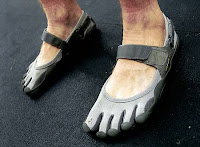
  3. Choose your surfaces carefully- The ideal surface is a flat grass area free of rocks, such as a soccer or football field. You will eventually build up thicker skin on the balls of your feet and will be able to run on harder surfaces.
  4. Consider minimalist shoes- The Nike "Free" or Vibram "5 Fingers" are a great way to work into barefoot running.
  5. Try a barefoot walk- You can strengthen the muscles of the foot and ankle more when walking barefoot than walking with sneakers. When walking you do not need to worry about staying on the balls of your feet, a normal heel strike is suitable.

Harvard Study- Videos of Forefoot strike vs Heel strike

The Barefoot Professor


Saturday, September 4, 2010

Our Deepest Fear- By Marianne Williamson

Our deepest fear is not that we are inadequate. Our deepest fear is that we are powerful beyond measure. It is our light, not our darkness that most frightens us. Your playing small does not serve the world. There is nothing enlightened about shrinking so that other people won't feel insecure around you. We were all meant to shine, as children do. It's not just in some of us; it's in everyone. And as we let our own light shine, we unconsciously give other people permission to do the same. As we are liberated from our own fear, our presence automatically liberates others.

Wednesday, July 28, 2010

Mind Over Matter

We just talked about how the mind has been shown to be more powerful than morphine when we wrote about the placebo effect. The human mind is so powerful, yet most of us discount the power of positive thinking when we are in a tough situation.

I’m sure most everybody has heard the expression, “Mind over matter,” but how much do you really believe that expression. Mind over matter is the belief that the mind is more powerful than the body. Tony Robbins has even talked about through positive thinking, people can walk across a bed of hot coals. What if positive thinking could do more than just help a person overcome physical pain? What if positive, or negative, thinking could effect every aspect of your life?

There are many motivational speakers that believe that your mind does effect what happens in your life. In fact, the first universal law of attraction says, “Like attracts like.” Have you ever REALLY focused on something you truly wanted and not gotten it? If you focus on what you want on a daily basis, you can find a way to get it. I can honestly say that anything I have really wanted and focused on getting, I have gotten. I’m not talking about some fleeting thought that crossed my mind over the course of a day or two, but something that I was persistent with over weeks or months.

A vision board is a great way to help focus your thoughts on what you really want to achieve in your life. It can be clippings from a newspaper or magazine or pictures you find online, anything that is a physical representation of the goals you really want to achieve in your life. Your call to action this week is to create a visual representation of what you want in your life. While you are selecting objects, don’t try to create a plan for how you are going to get it, just focus on what you want to achieve. The how will eventually work itself out. A person I really look up to once said that you can go from Florida to California without seeing the entire path if you go a few feet at a time. Focus on what you want and if you are given an opportunity to take a few steps towards it your goal, take it. Anything can be achieved no matter how far away it may seem as long as its taken a few feet at a time.

Tuesday, July 27, 2010

Your Mind is More Powerful than Morphine

When health is discussed, most people immediately focus on physical well-being, but health is also a state of mental and social well-being; true health is only 1/3 physical. Even if we take amazing care of our bodies, true health can never be achieved unless we have a healthy mind.

The best way to convey the vast power of the mind is by explaining the power of the placebo. Henry Knowles Beecher, M.D., made a huge contribution to our knowledge of the human body when he discovered the placebo effect. Beecher began investigating the relationship between subjective psychological states and objective drug responses during World War II. Beecher was an anesthetist involved in treating wounded soldiers and during the height of the war morphine supplies ran out. In desperation, Beecher injected saline solution
into the wounded soldiers instead of morphine. When the soldiers were injected with the saline, they were told it was morphine and the pain would go away. To Beecher's surprise, shortly after the injection the soldiers reported that the “morphine” eased their pain. Beecher wrote about his findings, stating, “Three-quarters of badly wounded men, although they had received no morphine for hours...have so little pain that they do not want pain relief medication, even though...such is available for asking.” This vital discovery by Beecher lead him to write one of the most influential papers in medicine, The Powerful Placebo, leading to the prospective, double-blind, placebo-controlled clinical trials used as the standard of testing new medicines today.

Medical researchers are constantly frustrated with the fact that the drug or surgery they are testing often achieves the same results as a placebo (a fake drug or surgery). More emphasis is now being put on researching why placebos are so effective, yet the answer is simple. Your mind controls your body. Your mind is what controls the healing power in your body. Why is that a cut on our arm heals without us having to think about it, but we are told we cannot heal from an illness or disease without help? Many in our society rely heavily on medicine to "heal" the problems in their bodies and give little credit to the body's own ability to heal itself. When somebody spontaneously heals from a life-threatening disease or an illness without the use of medicine, doctors quickly credit the results as miracle, giving no credit to the body's ability fight the disease and heal itself. The fact is, we are born with an amazing healing power in our bodies, and when the body is functioning properly, it can innately heal itself. It is becoming more and more essential that the accountability of our health is shifted from "bad genetics" and a "pill for every ill" back to the individual. We need to learn when it is necessary to seek emergency medical care and when our bodies can handle it on their own. Everything you do to your body either takes away from health or adds to it; taking away life or adding to it. If we can accept that we are responsible for how well our body functions, we allow ourselves to live a life of true health, living up to our full potential and taking away the constant fear of sickness and disease. When we accept responsibility, we take back control and allow ourselves to live a life that is truly fulfilling.

References:
American Society of Anesthesiologists- http://www.asahq.org/Newsletters/1999/09_99/beecher0999.html
Mary Robinson Reynolds, M.S. http://www.makeadifference.com/publish/articles.php?c=0d14_PEC

Monday, July 5, 2010

The RAW Truth about Food:

The process of pasteurization was invented by Louis Pasteur to ensure that food was safe for everyone to eat. The problem with this process is that it doesn't just kill the bad bacteria, it also kills the good bacteria and enzymes and takes away vitamins and minerals. Eating some foods raw is actually a great way to ensure that you will get all of the vitamins, undamaged proteins, and unoxidated fats.

Raw food is simply uncooked (never heated about 188 degrees Fahrenheit), unprocessed (as few ingredients as possible), and organic (no preservatives or pesticides). There are several reasons why it is best to eat some foods raw. When a food is cooked over 188 degrees, the enzymes needed to digest your food are killed off, along with most of the vitamins and minerals. It also changes the pH of the food, making it more acidic, and denatures the proteins and oxidizes the fats. A good way to think about eating raw foods is when you pick a living vegetable or fruit it continues to ripen, but once it is cooked it starts to decay.

Incorporating a raw food diet is easy to do and the rewards can be amazing. Some of the benefits that occur when a diet is 75 percent raw include: more energy, requiring less sleep to feel refreshed, weight loss, less susceptibility to colds and the flu, decreased allergies, better functioning immune system, decreases symptoms of PMS, and increased sexual function.

There are many types of raw food diets that limit what you eat or force you to completely revamp your diet. For some people, something like that may be necessary, but for others the most important thing is finding a way to incorporate raw foods into your current diet so that it can become a long term change.

For recipes or ideas regarding raw foods you can check out these websites:
http://www.rawinten.com/
http://www.sustainabletable.org/
http://www.thebestofrawfood.com/

Wednesday, June 30, 2010

The Value of Health: The Value of Life

What is the value of health? Of your health? Of your life? Can you put a price on it? Why is it that we are not willing to invest in our health by preventative means, yet when faced with a crisis situation we are willing to shell out tens of thousands of dollars! Why is it that we never make time for our health?

Your value system dictates how you spend your time. The things you value the most are the things you make the most time for; the things you value the least are usually the things you never quite get around to. Although the majority of people say they value their health, those same people usually are the ones who say they don't have time to exercise or to eat right. Without your health NOTHING else matters. You can spend your life working hard to raise an amazing family, get that big promotion and build your dream home, but without your health none of that matters. If you are not able to enjoy the time with your family because your body is filled with disease, nor be around to watch your grandchildren grow, what did you work so hard for? Many parents tend to neglect their own health in order to give their children everything, but your children need you to take care of yourself. If you are unhealthy, how are you able to be there for your children or take care of them? If something were to happen to you, think of the burden they are left with.

It can sometimes be difficult to find examples of science and religion agreeing, but one very important issue that the two agree on is how long humans are supposed to live. Genesis 6:3 states, “My spirit will not remain in humans forever because they are flesh. They will live only 120 years.” In 2005, Harvard put out a special health report stating that the human body is designed to live 120 years in perfect health.

So what is “perfect health?” Perfect health is not having to take medications. Perfect health is when the body is functioning the way it is designed to. When we eliminate toxins, stay active, eat the right nutrients, and have the right frame of mind we allow our body to function the way it is designed to. Living the life you were created to live cannot be achieved following the average American lifestyle. How many people that you know in their 60's are healthy? (Meaning they are not on medication and are still physically active). According to way our body was designed, when we are 60 we are only supposed to be half way through our life.

Perfect health cannot be achieved by changing only one aspect of your life. It takes effort and dedication, but the rewards of feeling true health are certainly worth it. The people that achieve lasting health make lifestyle changes and do not look at their health as something that can be managed with a quick fix.

Monday, June 21, 2010

The Human Body- The Whole is Greater than the Sum of its Parts

Inductive Reasoning works by moving from specific observations to generalizations and theories, known as the bottom up approach. Beginning with observations and measurements, patterns are looked at to form hypotheses, which are then developed into conclusions or theories.

Deductive Reasoning works just the opposite, from the more general to the more specific, the above down approach. Beginning with a theory, deductive reasoning works to confirm that theory. Aristotle summarized the principle of holism with the saying, “The Whole is more than the sum of its parts.” This is true for the human body. If a person who is considered dead has all of the parts that make up a human being, why are they not alive? If you take someone who dies of heart failure and put a new heart in them, will they come back to life? Of course not, because the whole is greater than the sum of the parts. The complex system that makes up the human body cannot be explained by reducing it to it's fundamental parts. We cannot keep thinking that we are smarter than our own bodies. By taking medications which alter the chemistry of our bodies we are messing with a complicated system that after hundreds of years of studying we still haven't even begun to understand.

Although sickness and disease are common, they are not normal. Our body is meant to be in a state of health. Sickness and disease do not occur randomly, no one gets sick by accident. When imbalance is allowed to occur in your body, order turns to chaos and disease results.

Epidemiology, the science that studies outbreaks of disease, explains that the existence of disease depends on three factors: 1. the host (the person who is the target of the disease), 2. the agent (the cause of the disease), 3. the environment (where the host and agent come in contact). This explains why two people can come in contact with the same bacteria/virus and only one of them gets sick. The one who did not get sick had a stronger healing system, a stronger host resistance. Just because we come in contact with an agent of disease does not mean we will fall victim to it, and although we cannot always avoid exposure to a disease causing agent, we can build up our bodies' defense system so attacks will be less successful. If we shift the focus from studying bacteria/viruses, pharmaceuticals, and genetics, and instead focus on understanding how our bodies know how to defend and heal themselves, we will be much further along in learning how to prevent illness and heal disease.